
If you’ve ever stood in front of your pet’s bowl wondering, “Am I giving them too much… or not enough?” — you’re not alone. Overfeeding is one of the most common mistakes pet owners in the U.S. make, and underfeeding is just as damaging. The good news? A Pet Food Calculator takes the guesswork out of mealtime completely.
In this guide, you’ll learn exactly how a pet food calculator works, what factors determine the right portion size for your dog or cat, how to read your pet’s body condition, and how to build a feeding routine that supports a long, healthy life — all backed by up-to-date nutritional science.
Ready to take control of your pet’s diet? Let’s dive in.
What Is a Pet Food Calculator?
A Pet Food Calculator is a science-based tool that calculates the precise daily food portion your pet needs based on their individual profile — weight, age, breed size, activity level, and health status. Instead of relying on the generic scoop printed on the back of a dog food bag (which is almost always more than your pet needs), a calculator gives you a personalized answer.
Think of it like a nutrition tracker for your pet. Just as humans use calorie-counting apps to manage their diet, a pet food calculator does the same thing — but for your furry family member.
At PetToolsHub, our free Pet Food Calculator is designed specifically for U.S. pet owners who want science-backed guidance without needing a vet visit for every feeding question.

Why Guessing Your Pet’s Food Portions Is Dangerous
Most people eyeball their pet’s food. A scoop here, a handful there. It feels natural — and it feels like love. But the reality is that consistently overfeeding or underfeeding your pet can lead to serious, expensive, and even life-threatening health problems.
The Real Risks of Overfeeding
According to the Association for Pet Obesity Prevention, over 59% of dogs and 61% of cats in the United States are overweight or obese. The consequences go far beyond looking pudgy:
- Joint disease and arthritis — excess weight puts daily stress on hips, knees, and elbows
- Type 2 diabetes — especially common in overweight cats
- Heart disease — obesity forces the heart to work harder
- Respiratory problems — extra fat constricts breathing
- Shortened lifespan — studies show obese pets live 2–2.5 years fewer than lean pets
The Hidden Dangers of Underfeeding
Underfeeding is less discussed but just as harmful:
- Muscle wasting and weakness
- Compromised immune function — pets get sick more often
- Poor coat quality and excessive shedding
- Stunted growth in puppies and kittens
- Behavioral issues from constant hunger
A pet food calculator keeps your pet in the healthy middle — not too much, not too little.
What Does a Pet Food Calculator Actually Measure?
A good pet food calculator takes multiple factors into account. Here’s what goes into building an accurate daily portion:
1. Current Body Weight
Weight is the foundation of every calculation. A 10-pound Chihuahua and a 70-pound German Shepherd have radically different caloric needs. You’ll need an accurate weight — not a guess from three months ago.
Pro tip: Weigh your pet monthly. Stand on your home scale alone, then again holding your pet. The difference is their weight.
2. Life Stage and Age
Your pet’s age dramatically changes how many calories they need:
- Puppies and kittens (0–12 months): Growing rapidly, need 2–3x more calories per pound than adults. Skimping here can permanently stunt development.
- Adult pets (1–7 years): In maintenance mode — the goal is to keep them lean and energetic without excess.
- Senior pets (7+ years): Metabolism slows, but protein needs actually increase to preserve muscle mass. Calories should drop slightly.
Speaking of age — do you know how your pet’s age compares to human years? It’s not as simple as the old 7-year rule suggests. Check out our in-depth breakdown in Dog Age Calculator: Convert Dog Years to Human Years to understand exactly which life stage your dog is really in — it directly affects their nutritional needs.
3. Breed and Size Category
Breed size has a major impact on feeding calculations, especially for dogs:
- Toy and small breeds (under 20 lbs) — fast metabolism, need more calories per pound
- Medium breeds (20–50 lbs) — moderate caloric needs
- Large and giant breeds (50+ lbs) — slower metabolism per pound, need controlled portions to protect joints
For cats, breed matters less than for dogs, but body frame still plays a role.
4. Activity Level
A dog who gets two brisk walks and a 30-minute fetch session daily needs significantly more food than a dog who mostly lounges on the couch. Most pet food calculators use these categories:
- Sedentary (little to no exercise) — reduce daily calories by 20–30%
- Moderately active (30–60 min exercise daily) — standard maintenance calories
- Highly active (working dogs, athletic breeds, daily intense play) — increase by 20–40%
- Working dogs (police K9s, herding dogs, hunting dogs) — may need double their resting caloric needs
5. Reproductive Status
This is one of the most overlooked variables in pet feeding:
- Spayed/neutered pets need 20–30% fewer calories because their metabolism slows after surgery
- Pregnant females need up to 50–100% more calories, especially in the final weeks
- Nursing mothers may need 3–8x their normal calorie intake depending on litter size
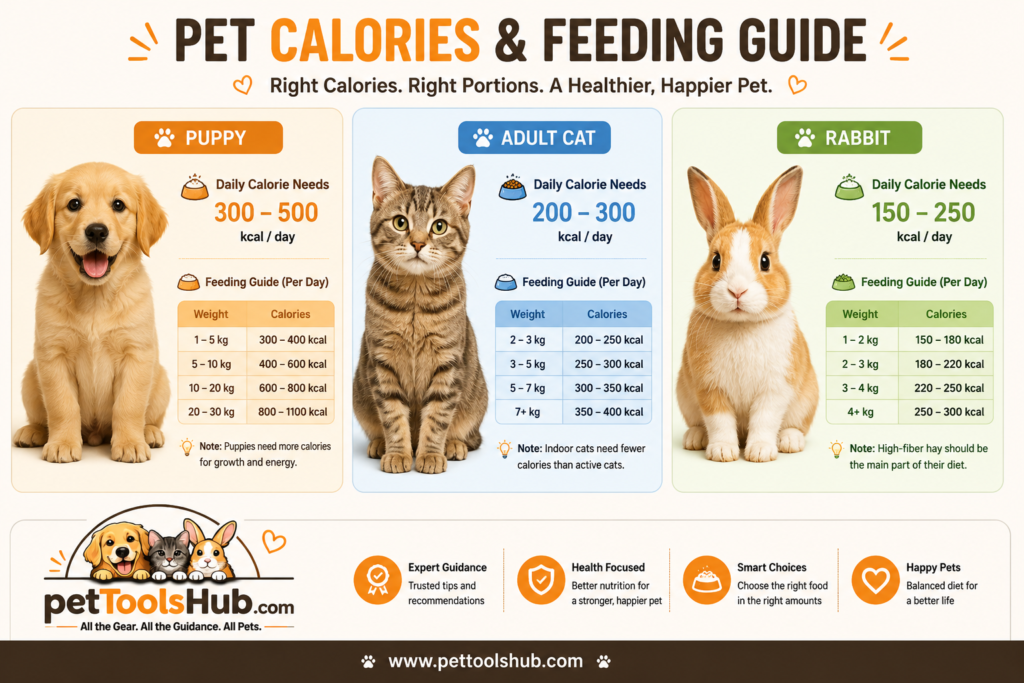
How to Calculate Your Pet’s Daily Calories (The Science)
If you want to understand how the numbers work, here’s the formula veterinary nutritionists use:
Step 1: Calculate Resting Energy Requirement (RER)
RER = 70 × (body weight in kg)^0.75
This gives you the baseline calories your pet burns just staying alive — breathing, circulating blood, maintaining body temperature.
Example: A 10 kg (22 lb) dog RER = 70 × (10)^0.75 = 70 × 5.62 = 393 kcal/day
Step 2: Multiply by a Life Stage Factor (MER)
| Life Stage | Factor |
| Neutered adult | RER × 1.6 |
| Intact adult | RER × 1.8 |
| Inactive / obesity-prone | RER × 1.2–1.4 |
| Weight loss | RER × 1.0 |
| Puppy under 4 months | RER × 3.0 |
| Puppy 4–12 months | RER × 2.0 |
| Pregnant (late) | RER × 3.0 |
| Nursing | RER × 4.0–8.0 |
| Light work | RER × 2.0 |
| Heavy work | RER × 4.0–8.0 |
Continuing the example: 10 kg neutered adult dog MER = 393 × 1.6 = 629 kcal/day
Step 3: Convert to Food Amount
Check your food bag’s calorie density (kcal per cup or per 100g). Divide your pet’s daily calorie target by the food’s calorie density.
Example: If your food has 350 kcal per cup: 629 ÷ 350 = 1.8 cups per day
This is something our Pet Food Calculator at PetToolsHub handles instantly — no math required.
Feeding Guide by Pet Type
Dogs: Daily Food Portions at a Glance
This table shows approximate dry kibble amounts for adult dogs of average activity. Always verify with calorie-specific calculations for your food brand.
| Dog Weight | Daily Dry Kibble (approx.) |
| 5–10 lbs | ½ – ¾ cup |
| 10–20 lbs | ¾ – 1½ cups |
| 20–40 lbs | 1½ – 2½ cups |
| 40–60 lbs | 2½ – 3½ cups |
| 60–80 lbs | 3 – 4 cups |
| 80–100 lbs | 4 – 4½ cups |
| 100+ lbs | 4½+ cups |
These are starting points. Adjust based on your dog’s body condition every 2–4 weeks.
Cats: Daily Calorie Needs
Cats are obligate carnivores — they require animal-based protein to survive. Unlike dogs, they have limited ability to use carbohydrates for energy.
| Cat Weight | Daily Calories (approx.) |
| 4 lbs | ~120–140 kcal |
| 6 lbs | ~150–180 kcal |
| 8 lbs | ~190–220 kcal |
| 10 lbs | ~220–260 kcal |
| 12 lbs | ~260–300 kcal |
Wet vs. Dry Food for Cats: Wet food provides essential hydration and is often preferred by cats. Dry food supports dental health but requires you to ensure your cat drinks plenty of water. A combination of both is the most balanced approach.
How to Assess Your Pet’s Body Condition (BCS)
Even with perfect calculations, you need to check results with your eyes and hands. The Body Condition Score (BCS) is the gold standard tool vets use:
The 9-Point BCS Scale:
- 1–3 (Underweight): Ribs, spine, and hip bones are clearly visible. No fat padding. Immediate diet increase needed.
- 4–5 (Ideal): Ribs are easily felt but not seen. Waist is visible from above. Slight tuck when viewed from the side. This is the goal.
- 6–7 (Overweight): Ribs are hard to feel under fat. Waist barely visible. Abdomen may sag.
- 8–9 (Obese): Ribs impossible to feel. No waist. Heavy fat deposits visible. Serious health risk.
Check your pet’s BCS every 4 weeks. It’s the best way to tell if your current portions are working — or if adjustments are needed.
How Often Should You Feed Your Pet?
Portion size is only half the picture. Meal frequency matters too.
Dogs
- Puppies 8–12 weeks: 4 meals per day
- Puppies 3–6 months: 3 meals per day
- Puppies 6–12 months: 2 meals per day
- Adult dogs: 2 meals per day (morning and evening)
- Senior dogs: 2 smaller meals per day (aids digestion)
Avoid free-feeding dogs. Leaving food out all day makes it nearly impossible to track intake and is a direct path to obesity.
Cats
Cats can handle meal feeding (2–3 set mealtimes) or scheduled free-feeding with measured portions. However, free-feeding is only appropriate if your cat maintains a healthy weight — many cannot self-regulate.
Reading Pet Food Labels: What to Look For
Your pet food calculator is only as accurate as the food information you feed into it. Here’s how to read labels correctly:
Ingredients list: Ingredients are listed by weight before processing. Look for a named protein (chicken, beef, salmon) as the first ingredient — not “meat meal,” “corn,” or “by-products” as the lead item.
“Complete and Balanced”: This phrase means the food meets AAFCO (Association of American Feed Control Officials) nutritional standards for the life stage listed. Always verify it matches your pet’s current stage.
Calorie statement: Look for kcal/cup or kcal/kg. This is essential for accurate calculation. If it’s not on the bag, it’s on the brand’s website.
Life stage: “All Life Stages” is appropriate for puppies and pregnant/nursing animals. “Adult Maintenance” is for adult pets only.
Common Pet Feeding Mistakes That Sabotage Your Results
Even with a calculator, these habits can derail your pet’s nutrition:
Mistake #1: Counting treats separately — or not at all. Treats are calories. They must be factored into your pet’s daily total. Treats should make up no more than 10% of daily calories.
Mistake #2: Using the bag’s feeding guide as gospel. Pet food companies have a financial incentive to recommend higher portions. Use a calculator, not a bag.
Mistake #3: Not adjusting after spaying or neutering. This is one of the most common triggers of pet weight gain. Reduce portions by 20–30% post-surgery.
Mistake #4: Skipping the weight check. Your pet’s weight changes over time. Recalculate portions every 3–6 months, or whenever your pet’s lifestyle changes significantly.
Mistake #5: Giving too much human food. Table scraps are often high in fat, sodium, and calories. Some human foods — like onions, grapes, raisins, xylitol, and chocolate — are outright toxic to pets.
When to Adjust the Calculator’s Recommendation
The numbers your calculator produces are a starting point, not a permanent prescription. Adjust if:
- Your pet loses weight faster than 1–2% per week (too aggressive)
- Your pet gains weight despite being on a “maintenance” plan (reduce by 10%)
- Your pet seems constantly hungry and anxious at mealtimes (slight increase may be needed)
- Your pet leaves food uneaten consistently (slight reduction)
- Your pet enters a new life stage (puppy to adult, adult to senior)
- Your pet is diagnosed with a health condition like kidney disease, diabetes, or allergies
How PetToolsHub Supports Your Pet’s Complete Health
A good feeding plan doesn’t exist in isolation. It connects to every other aspect of your pet’s wellbeing. That’s exactly why PetToolsHub offers a full suite of free calculators to support every part of pet ownership:
- Pet Food Calculator — Daily portion sizes tailored to your pet
- Pet Calorie Calculator — Precise daily calorie targets
- Pet BMI Calculator — Check if your pet is at a healthy weight
- Pet Water Intake Calculator — How much water your pet needs daily
- Dog Age Calculator — Understand your dog’s true life stage in human years
- Dog Pregnancy Calculator — Estimate your dog’s due date and prepare for the litter
- Pet Cost Calculator — Budget for food, vet care, and monthly expenses
Each tool is free, instant, and built for real pet owners who want accurate answers without spending an hour researching.

Frequently Asked Questions
How much dry food should I feed my dog per day?
It depends on your dog’s weight, age, activity level, and the specific food’s calorie content. As a general starting point, a 30-pound adult dog needs roughly 2 to 2.5 cups of standard dry kibble daily — but this can vary significantly. Use a Pet Food Calculator for your exact situation.
Is it okay to feed my cat only dry food?
It’s possible but not ideal. Dry food has low moisture content, which can contribute to urinary tract issues and kidney stress in cats. Many vets recommend mixing wet and dry food to ensure adequate hydration.
How do I know if I’m feeding my dog enough?
Check their Body Condition Score monthly. You should be able to feel their ribs easily without pressing hard, see a defined waist from above, and notice a slight abdominal tuck from the side. If ribs are invisible and waist is gone, reduce portions.
Should I feed my senior dog differently?
Yes. Senior dogs need fewer calories (their metabolism slows) but higher quality protein to preserve muscle. Look for senior-specific formulas and consider joint support supplements. Visit our Dog Age Calculator to determine if your dog has entered their senior stage.
My dog is overweight. How do I use the calculator to help them lose weight?
Set your dog’s target weight (not current weight) in the calculator, then use the “weight loss” life stage factor (RER × 1.0). Aim for a loss of no more than 1–2% of body weight per week. Monitor their BCS monthly and adjust as needed.
Final Thoughts
Feeding your pet the right amount — every day, consistently — is one of the most powerful things you can do for their long-term health. It prevents obesity, supports healthy joints, maintains energy levels, and can genuinely add years to their life.
A Pet Food Calculator removes the guesswork. It gives you a personalized, science-based starting point — and combined with regular body condition checks and occasional vet consultations, it’s a system that actually works.
Whether you have a playful Labrador puppy, an aging Persian cat, or a hardworking Border Collie, PetToolsHub’s free Pet Food Calculator gives you the right answer in seconds.
Your pet gives you unconditional love every single day. Giving them the right food in the right amount is the simplest, most effective way to love them back.